
The sigPCA package provides tools to assess the
statistical significance of principal components using methods from
random matrix theory, particularly the Marchenko–Pastur (MP)
distribution. It also includes an optional permutation-based method for
empirical validation.
#
install.packages("pak")
pak::pak("guillermodeandajauregui/sigPCA")set.seed(123)
X_white <- matrix(rnorm(1000), nrow = 100, ncol = 10)
result_white <- sigPCA(X_white, method = "both", num_permutations = 100)
result_white$mp$significant_components
#> integer(0)
plot_sigPCA(result_white$mp$eigenvalues, result_white$mp$mp_bounds)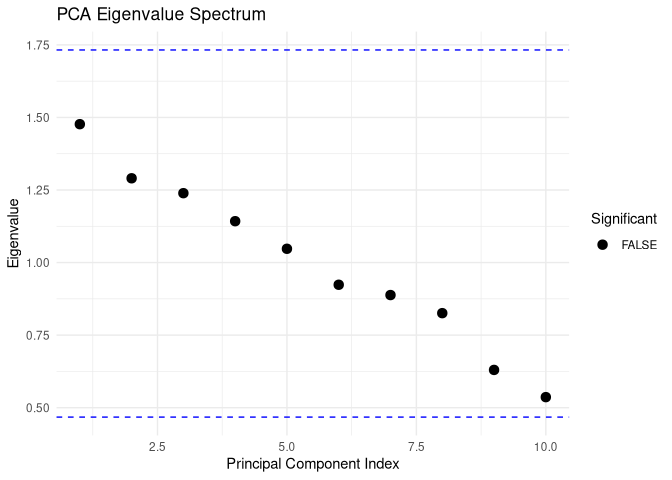
set.seed(456)
{
  n <- 100
  p <- 10
  k <- 2
  latent <- matrix(rnorm(n * k, mean = 3), nrow = n, ncol = k)
  loadings <- matrix(rnorm(p * k), nrow = k, ncol = p)
  noise <- matrix(rnorm(n * p, sd = 0.3), nrow = n, ncol = p)
  X_signal <- latent %*% loadings + noise
  result_signal <- sigPCA(X_signal, method = "both", num_permutations = 100)
}
result_signal$mp$significant_components
#> [1] 1 2
plot_sigPCA(result_signal$mp$eigenvalues, result_signal$mp$mp_bounds)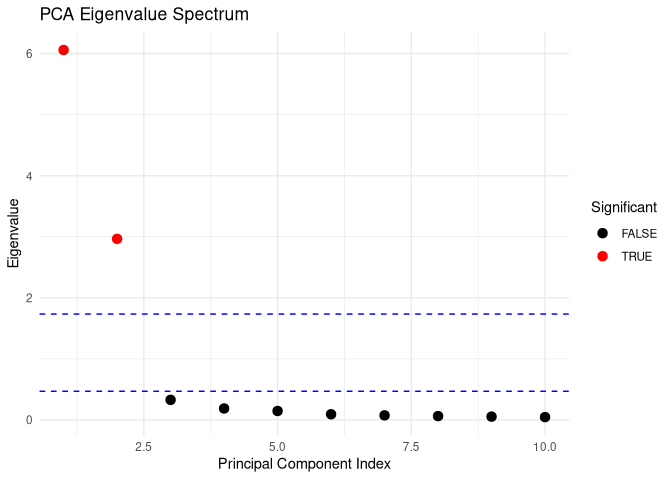
Components with eigenvalues beyond the theoretical Marchenko–Pastur upper bound are considered statistically significant. This method is particularly effective for high-dimensional datasets where traditional heuristics like scree plots may be misleading.
The permutation-based method provides empirical p-values and is useful as a secondary or confirmatory approach.