
This R package provides a class that generates experiment sFFLHD designs. Sequential full factorial-based Latin hypercube design were created by Duan, Ankenman, Sanchez, and Sanchez (2015, Technometrics).
To create a new design you use the function sFFLHD$new
and must give in the number of dimensions, D, and the batch
size/number of levels per factor, L. An example is shown
below (the last line can be repeated when run in console to see how new
batches are added).
library(sFFLHD)
#> Loading required package: DoE.base
#> Loading required package: grid
#> Loading required package: conf.design
#>
#> Attaching package: 'DoE.base'
#> The following objects are masked from 'package:stats':
#>
#>     aov, lm
#> The following object is masked from 'package:graphics':
#>
#>     plot.design
#> The following object is masked from 'package:base':
#>
#>     lengths
set.seed(0)
s <- sFFLHD$new(D=2,L=3)
plot(s$get.batch(),xlim=0:1,ylim=0:1,pch=19)
abline(h=(0:(s$Lb))/s$Lb,v=(0:(s$Lb))/s$Lb,col=3);points(s$get.batch(),pch=19)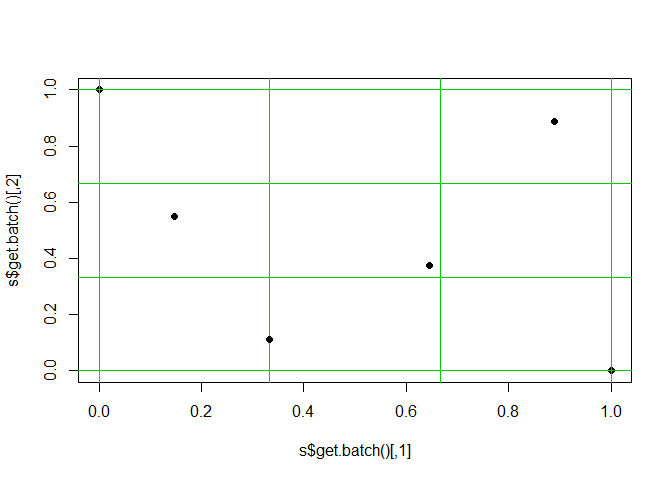
By default the new points are selected using maximin distance
optimization to spread them out. This is why points will end up near
corners. This option will slow down the code a little but generally not
noticeably compared to what the design is used for. If set to
FALSE then the points are randomly placed within their
small grid box.